Context
During my seventh-grade science student teaching, students researched an assigned element and presented its properties, structure, history, and uses through an Element Heroes project. Guided research notes and differentiated texts supported students identified through i-Ready reading scores, accommodations, and classroom observations. This artifact brings together the shared task, examples of support, completed research notes, and final projects.
Task Instructions and Targeted Supports
Project Instructions - Phases 1–2
Students researched atomic structure, physical properties, discovery and occurrence, uses, and interesting facts, then recorded information in their own words. The standard instructions required students to organize their findings in notebooks.
Guided Research Notes — Phases 1–2
The guided version retained the research categories while providing individual prompts and spaces for responses. It was provided to students requiring chunking and/or guided notes. Differentiated texts were provided according to reading scores and accommodations for chunking, guided notes, or extra time.
Boron — Original and Differentiated Text
Original source: Boron, Wikipedia
Original excerpt: “In its crystalline form it is a brittle, dark, lustrous metalloid; in its amorphous form it is a brown powder.” (Wikipedia contributors, n.d., introductory section, para. 1)
Differentiated Informational Text — Boron
Adapted excerpt: “A piece of boron can be surprising to look at and touch. Its crystals are dark gray or black, with a shiny luster. They may look like metal, but they do not bend easily. Instead, they are brittle and can break. Boron is classed as a metalloid because it shares some traits with metals and some with nonmetals. It can also take a different form as a brown powder.”
The adaptation breaks dense information into shorter sentences, explains terminology in context, and retains terms such as luster, brittle, metalloid, and conductivity. The full text provides relevant research information in connected prose, leaving students to locate and organize information rather than supplying a completed answer sheet. Boron illustrates the text adaptation; the completed organizer below concerns a different element, xenon.
Student Evidence
Guided Research Notes
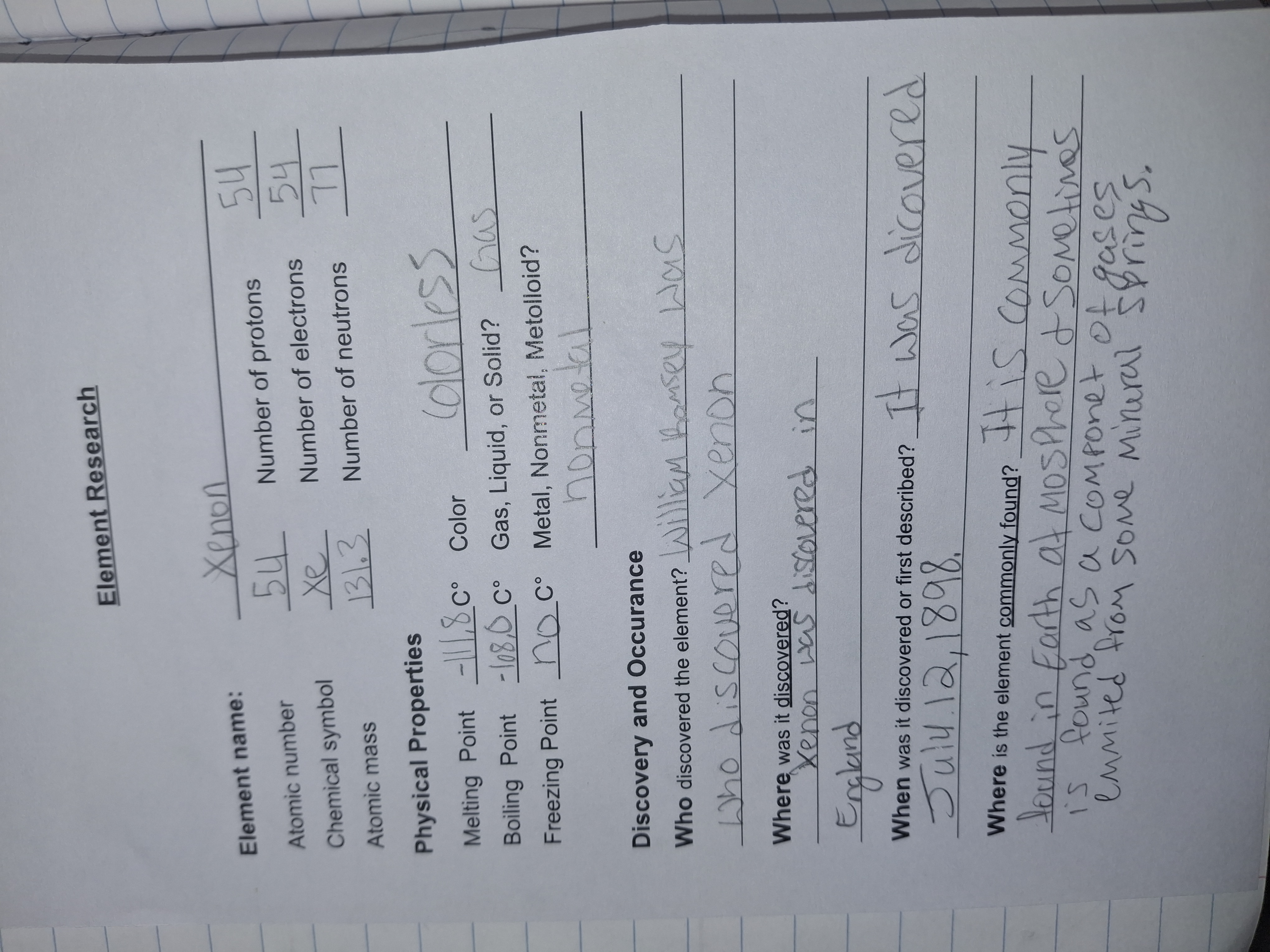
Xenon: atomic structure, physical properties, discovery, and occurrence. The student entered information in the organizer’s designated categories. Original work is preserved, including entries that require clarification; completion is not presented as proof of full accuracy.
Uses and Interesting Facts
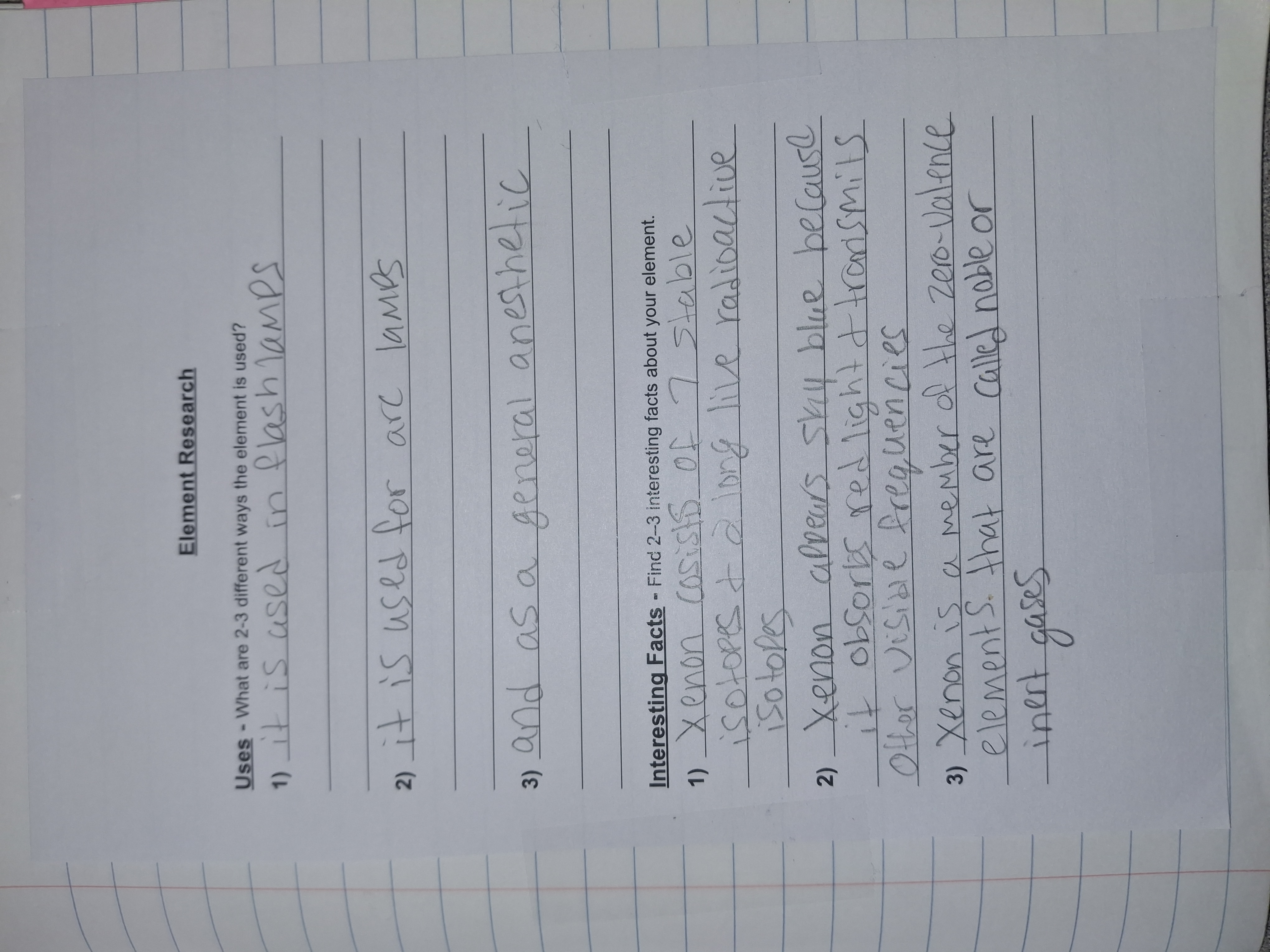
Xenon: the student recorded three uses and three facts in the guided format. These two notebook images show the scaffold in use; they are not a before-and-after comparison or evidence of the Boron text’s effect.
Project Scope — Hallway Display
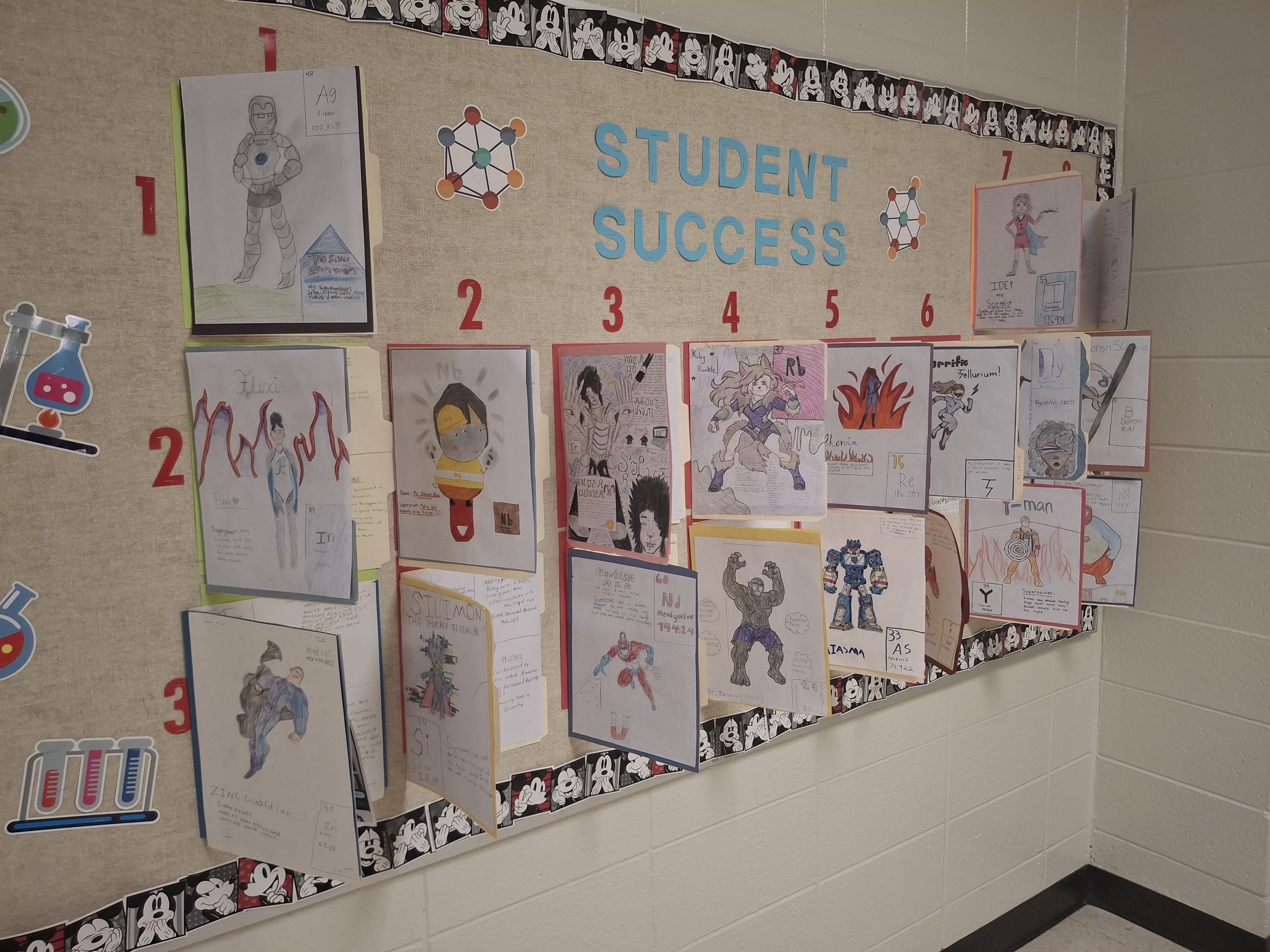
The display presents 18 examples of finished student work, showing the range of character designs and presentations. Students used different levels of support.
Independent Extension — Completed Cover
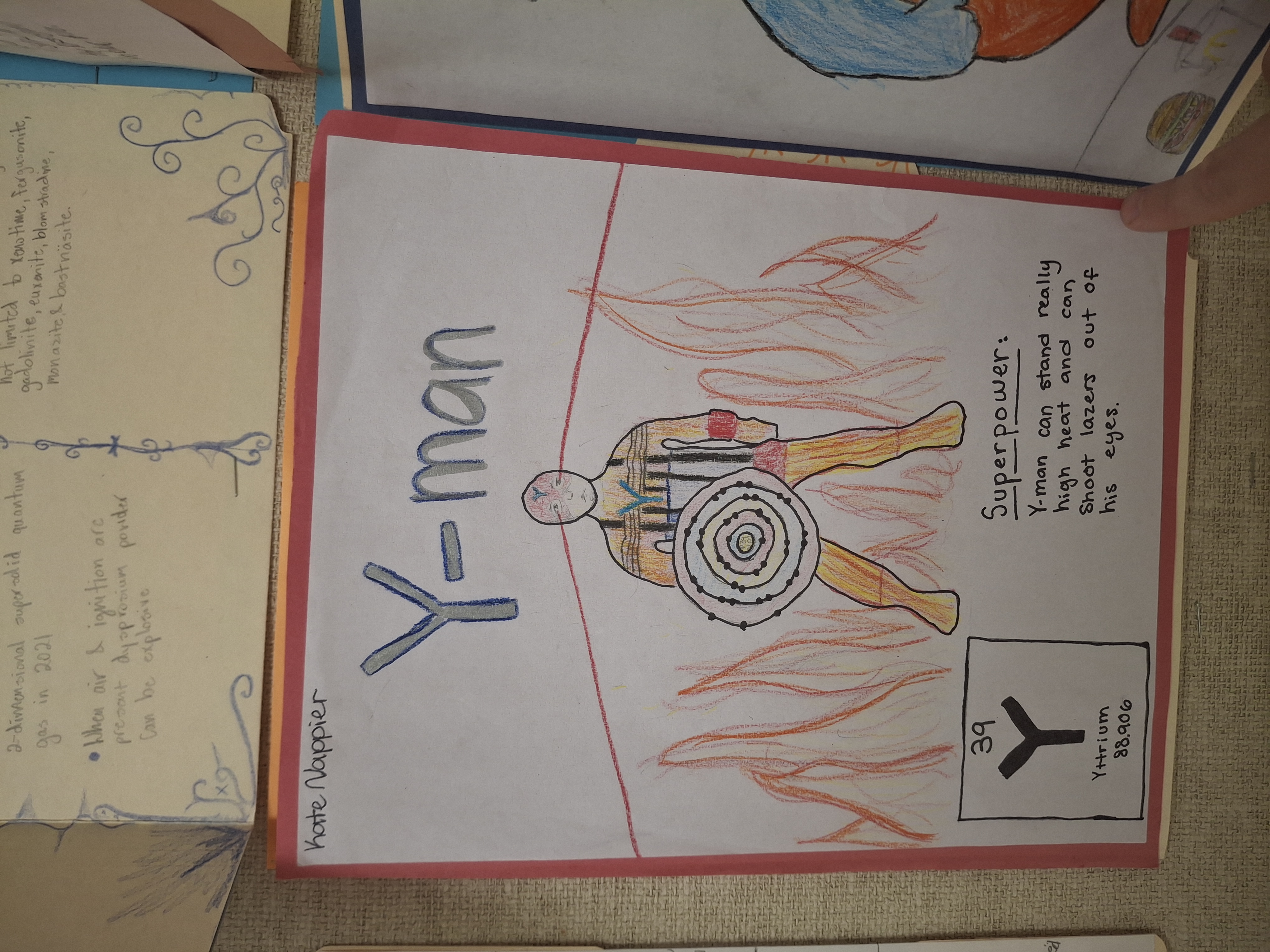
Yttrium: This gifted student completed the project without additional support. The cover combines the element’s symbol, a character design, and a superpower explanation. It illustrates the scope for independent creativity.
Independent Work — Completed Information
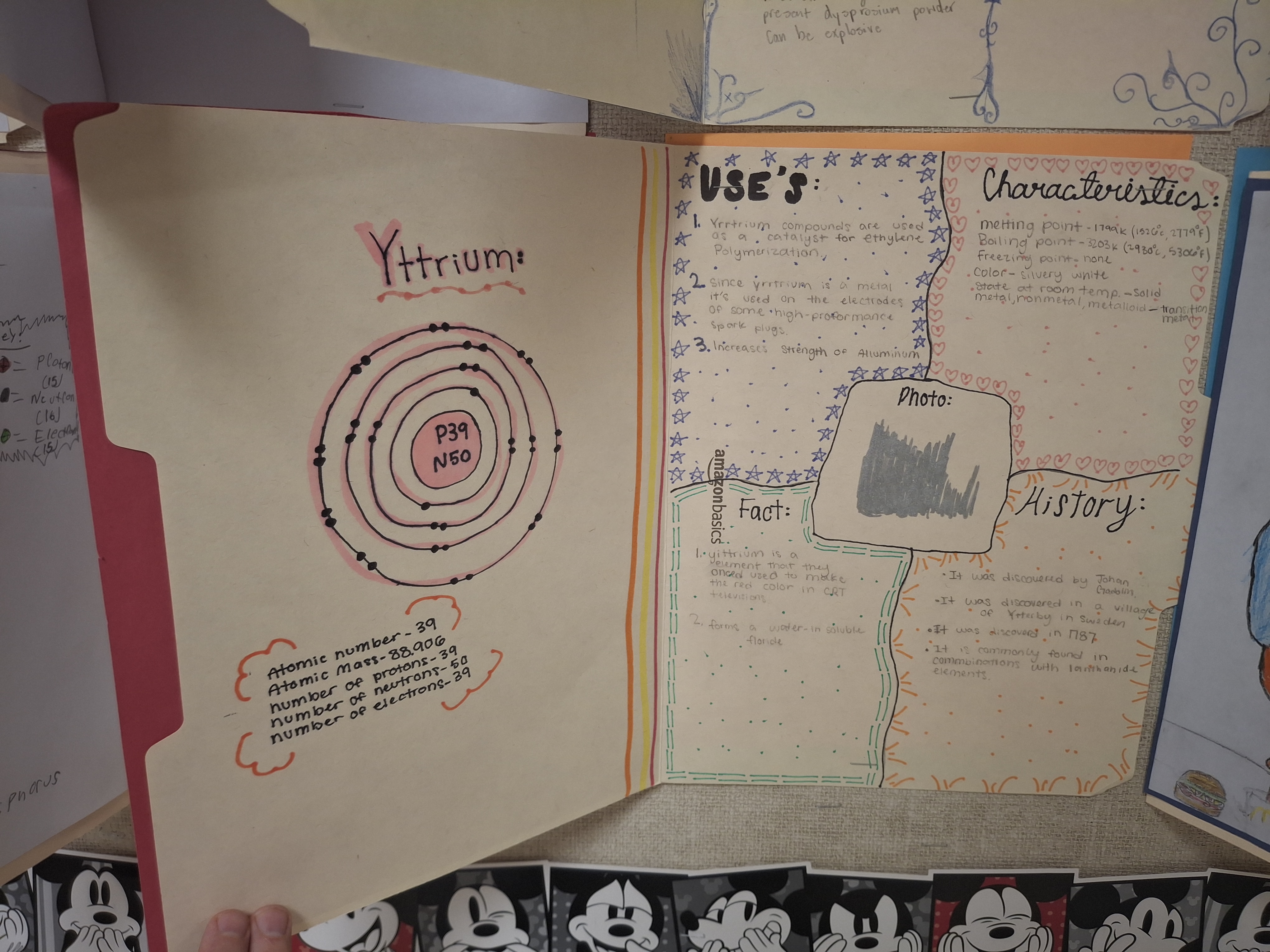
The inside of the same yttrium project brings together atomic structure, properties, uses, facts, and history in a student-designed layout. This is an example of independent organization and presentation, rather than a model answer or evidence that every entry is correct.
Competency and effect on learning
This artifact demonstrates how I differentiated the Element Project using i-Ready reading scores, student accommodations, and classroom observations. Many students had below-grade-level literacy scores. During instruction, I observed difficulty accessing text-based tasks, organizing ideas, and taking notes efficiently. When these demands became overwhelming, some students disengaged, went off task, or disrupted others.
I provided guided research notes to students whose accommodations required chunking and/or guided notes. I provided differentiated informational texts to students who required those supports or extra time, or whose i-Ready scores were below grade level. The notes divided the research into manageable categories and provided designated spaces for responses. The Boron example illustrates how shorter, more accessible prose could preserve scientific vocabulary and relevant information while still requiring students to read, select information, and organize it. Students worked toward the same research and presentation goals with different levels of support. I also offered character templates for students who found drawing difficult and used AI to help students develop character concepts when they struggled to generate ideas.
The completed xenon organizer shows a student using the support to record atomic structure, physical properties, discovery, occurrence, uses, and interesting facts. This provides evidence that the student could locate and organize information within the scaffold, although some entries remained incomplete or needed clarification. The hallway display shows the range of finished projects, while the yttrium cover and information pages show what a gifted student completed without additional support. Together, these examples demonstrate access to the shared task at different levels of independence; they do not establish that every student mastered every concept or that the Boron text produced the xenon responses.
Modifications for future use
A major difficulty was synthesizing research and scientific concepts into a single project, particularly when students had to connect an element’s properties to original superpowers. The complexity of the task and the detailed rubric contributed to the project taking five lessons instead of the three I had planned. Although the supports helped students organize information, the synthesis and character-design requirements added demands beyond the central goals of research and presentation.
I would simplify the rubric and place greater emphasis on accurate research, organization, and clear presentation. Instead of requiring every student to invent powers, I would provide a short list of scientifically connected powers for each element. Students could select from the list and focus their time on communicating their research. I would retain original character creation as an optional extension for gifted students, fast finishers, and any other student who wanted to go beyond the core requirements.
Under this revised approach, completing the core requirements accurately would earn approximately 90 points out of 100. An optional extension would allow students to earn the remaining points by developing and explaining an original, scientifically grounded connection between their element and character. I would make this opportunity available to all students, including those using supports, and clearly distinguish the core criteria from the extension. This would preserve creativity while reducing the organizational and synthesis demands that delayed completion of the essential learning tasks.
References
Wikipedia contributors. (n.d.). Boron. In Wikipedia. Retrieved October 24, 2026, from https://en.wikipedia.org/wiki/Boron
All portfolio references →Next: Educational Technology →