Context
During my seventh-grade science student teaching, students developed physical-property vocabulary through reading, a definition table, and a six-station element observation lab. This artifact includes selected instructional prompts, excerpts from a completed lab, and three student notebook pages. Full instructional materials and the completed lab are linked below. Student wording is preserved; the examples show both successful application and remaining misconceptions.
Instructional Materials
Physical Properties Reference Table — Student Handout
Students used two informational texts to complete a table organized by property, meaning, and how it could be checked. Completed examples appear on the notebook pages included in this artifact.
Element Observation Lab — Full Instructions and Station Tables
Each station required students to record an element’s color, luster, and state, followed by another detail, test result, or inference. The directions stated: “Use specific color words. Describe luster as shiny, dull, or mixed. Record state (solid, liquid, gas).” Students then answered “Show your thinking” questions to compare samples and explain their observations.
Student Evidence
Completed Notebook Notes
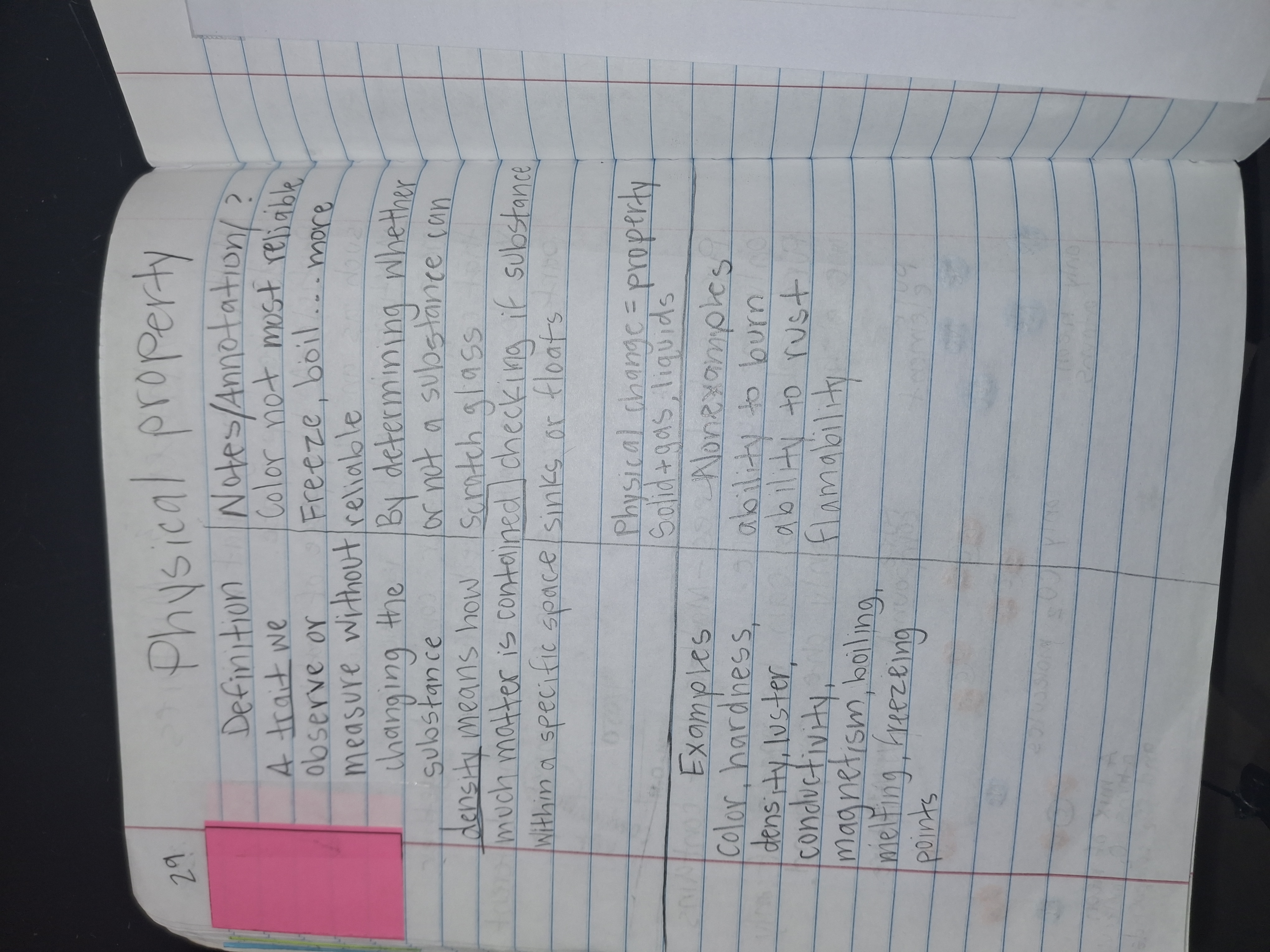
Notebook Example 1 — Physical Property Notes
Student definitions, annotations, examples, and nonexamples. Original image: Student Example - Notebook Page 1.
Click image to enlarge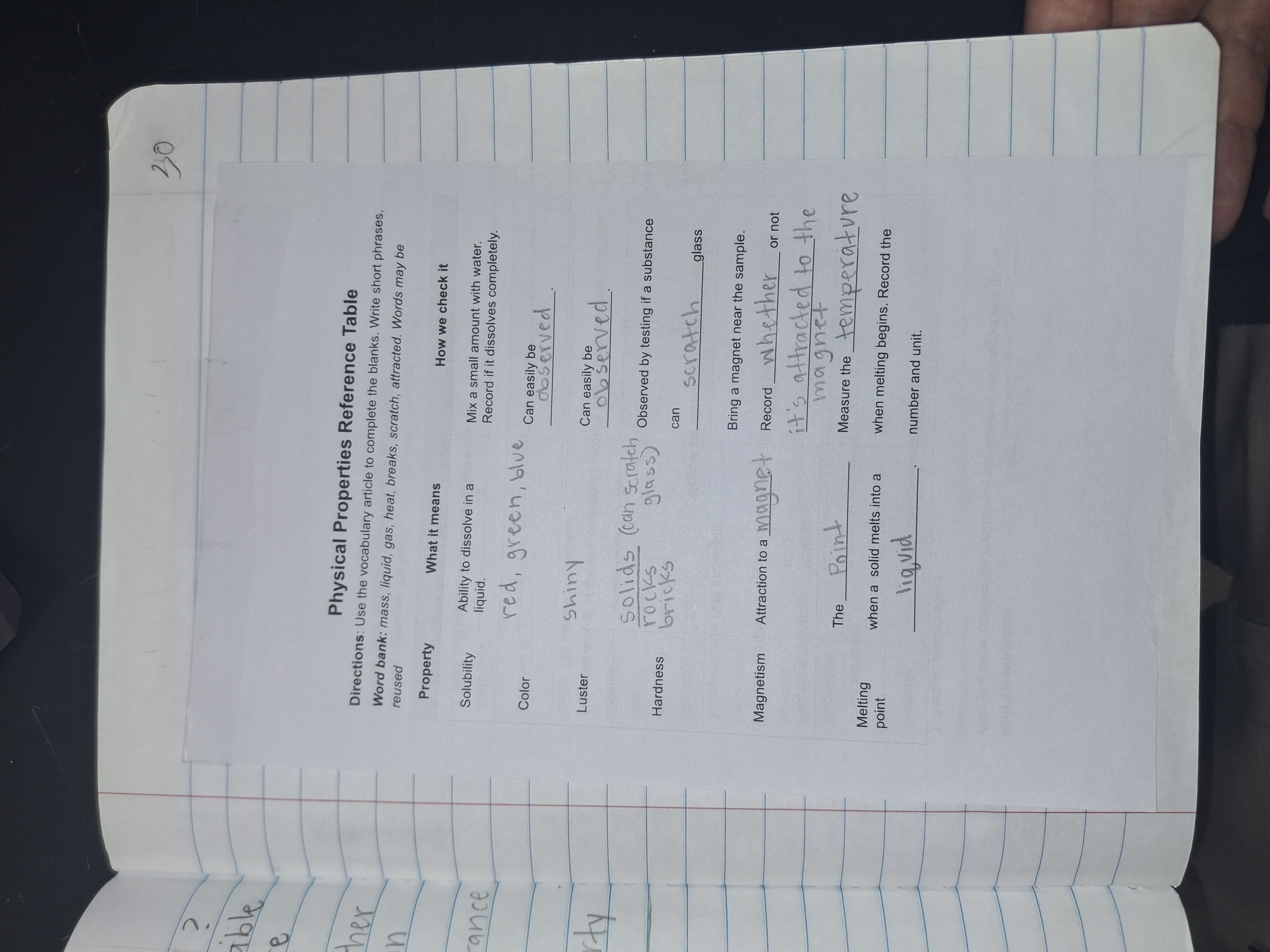
Notebook Example 2 — Reference Table
Completed reference table covering solubility, color, luster, hardness, magnetism, and melting point. Original image: Student Example - Notebook Page 2.
Click image to enlarge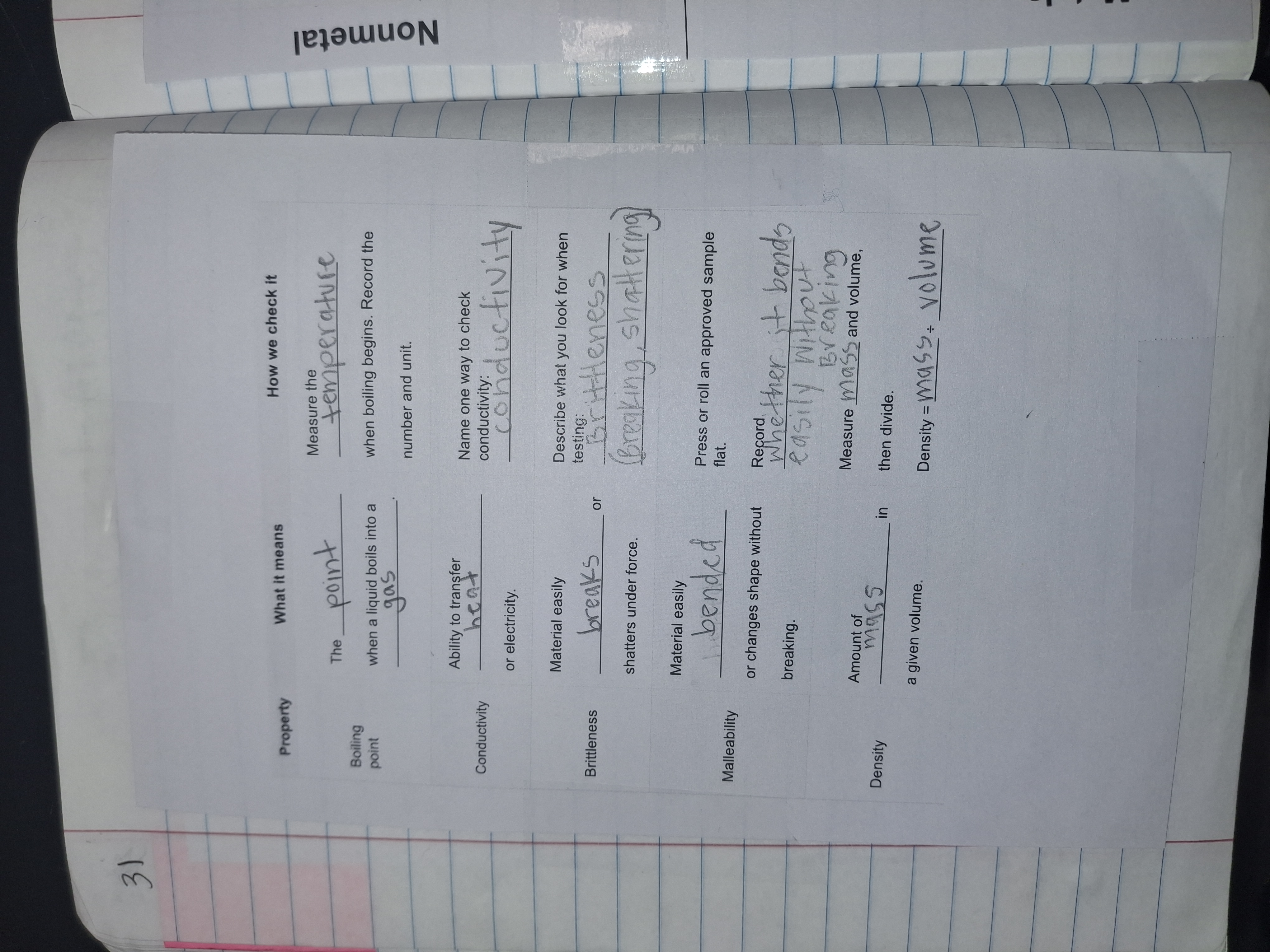
Notebook Example 3 — Reference Table
Completed reference table covering boiling point, conductivity, brittleness, malleability, and density. Original image: Student Example - Notebook Page 3.
Click image to enlargeElement Observation Lab — Complete Student Example
The following excerpts preserve the student’s wording and illustrate vocabulary use in both brief observations and extended responses.
Station 4 — Comparing Magnetic Properties
Prompt: “Compare the results of testing a magnet on all three samples. What is similar and what is different?”
Student response: “Only iron was magnetic while the others weren’t.”
Prompt: “Which combination of observed properties would help you separate these three samples? Explain why one property might not be enough.”
Student response: “Its shape and magneticity. Color wouldn’t be enough because most of them are the same color.”
Station 6 — Comparing Color and State
Prompt: “Which two samples show the greatest differences? Compare their state, color, or luster using specific observations.”
Student response: “Mercury and Gold. Mercury is silver and a liquid while gold is yellowish and a solid.”
Remaining Difficulties
These excerpts show why future instruction would distinguish observed or tested properties from tentative inferences.
Station 3 — Conductivity
The student recorded “Cube, cold maybe conductive?” for titanium and “cold , maybe conductive?” for chromium.
Station 6 — Conductivity
Prompt: “Choose a property to compare for all five samples. What pattern do you notice? Which sample is an exception, if any?”
Student response: “I think they all have conductivity because I noticed they are all cold. Mercury makes an exception because we can’t actually feel it because its harmful.”
Evidence note: The student attempted to apply conductivity vocabulary, but the responses do not report a conductivity test. Feeling cold alone does not establish electrical conductivity.
Competency and effect on learning
This artifact demonstrates how I taught academic language through reading, defining terms, and applying vocabulary to firsthand observations. I initially provided an informational text that students read and highlighted to answer guiding questions. They then used the reading to complete the Physical Properties Reference Table, connecting each property with its meaning and how it could be checked. Finally, students applied the vocabulary while gathering data in the element observation lab.
The primary vocabulary was color, luster, and state. Secondary vocabulary included magnetic, hard, brittle, malleable, and conductivity. Some secondary properties could not be tested at every station, so I encouraged students to make inferences. The “Show your thinking” questions asked students to use the vocabulary in meaningful comparisons and explanations beyond the brief entries expected in the data tables.
The lab connected vocabulary with actual samples and made elements on the periodic table more tangible. The student work shows application of the terms: one response compared mercury as silver and liquid with gold as yellowish and solid, while another explained that only iron was magnetic among the samples tested. The completed notebook tables also show students connecting terms with meanings and ways to check properties. These examples demonstrate that students could use academic language to describe and compare materials based on firsthand experience, although some responses showed difficulty distinguishing tested properties from inferences.
Modifications for future use
Students had difficulty using the secondary vocabulary to make supported inferences and answering some of the “Show your thinking” questions. For example, the completed lab included an inference about conductivity based on samples feeling cold rather than on a conductivity test. In future use, I would focus the required vocabulary and questions on properties students could directly observe or test with the available materials. I would require students to identify whether a statement came from an observation or test and allow them to record that a property had not been tested. This would help them use the vocabulary more accurately and support their statements with evidence.
I also allowed extra exploration time because I wanted students to enjoy examining actual elements. However, completing all six stations took two days, and I likely allowed more exploration time than was needed, which may have contributed to students becoming off task. I would significantly shorten and set clear limits for observation and data collection, then move the thinking questions to a separate activity after all station data had been collected. Students would use their recorded data to answer the questions rather than returning to the samples. This would place greater emphasis on recording useful observations and using academic language to explain comparisons based on evidence.
Next: Differentiated Instruction →